Aman Tahiliani · Atlanta

I build the systems thatbuild software.

Software engineer. I build agent infrastructure, pipelines that carry an idea from issue to reviewed, merged pull request, with humans at the gates that matter. Healthcare is where I learned to do it under real constraints: data that can't leave the VPC, a small shared AI budget, and 61 production instances that can't break.

Coding agents are good at writing code and bad at deciding what to write.

I got tired of babysitting them one prompt at a time, so I built a pipeline that treats them like contractors: a spec they can't misread, an isolated workspace, a build gate before anything earns a pull request, and a reviewer that is never the agent that wrote the code.

The box-box software factory pipelineThree phases: Groom, Implement, Review. A grooming agent interrogates the issue into a spec; a human approves it; a harness implements it in an isolated worktree behind a build gate; a different harness reviews it; a human merges.01 · GROOM02 · IMPLEMENT03 · REVIEWGitHub issueStage: Icebox → Researchgrill persona + architect lensseeded interrogation, not summarizationReady spec written into issue bodyEffort + Priority set on the ProjectHUMAN GATEyou read the spec and flip Stage → Readydev implement <issue> --harnessStage → In Progressisolated git worktreeown branch, own workspace, no collisionsharness runs headless on the specone adapter function per toolBUILD GATEfails → no PR is ever openedrejected work never reaches a humanPR openedStage → In Reviewreview skill, a different harnessthe agent that wrote it does not grade ittests + Playwright visual capturechecked against the spec in the issue.review packet + PR commentfindings posted where the work livesHUMAN GATEyou mergeStage → Done43 of 44 pull requests mergedhuman gate: the two decisions that stay mineautomated gate: rejects before a human is involvedharnesses: claude · codex · opencode · cursor · piantigravity: disabled 2026-07-04, headless path unreliable
The pipeline behind box-box. Two human gates; everything between them is unattended.

Six harnesses plug in through one adapter function each, and that is the only tool-specific code in the system. One is currently disabled, because when I tested its headless path it wasn't reliable enough to trust with unattended work. That row stays in the table, with the date on it.

How the factory works

An agentic SDLC inside healthcare compliance

Agents that read the ticket and the architectural decision record before they touch code. Isolated multi-repo worktrees so three tickets run at once without their migrations colliding. Scheduled jobs that write my standup notes and my sprint demo docs. A Playwright gate that lowered the share of my tickets QA sends back.
BEDROCK · DJANGO · PLAYWRIGHT · SCHEDULED AGENTS

box-box

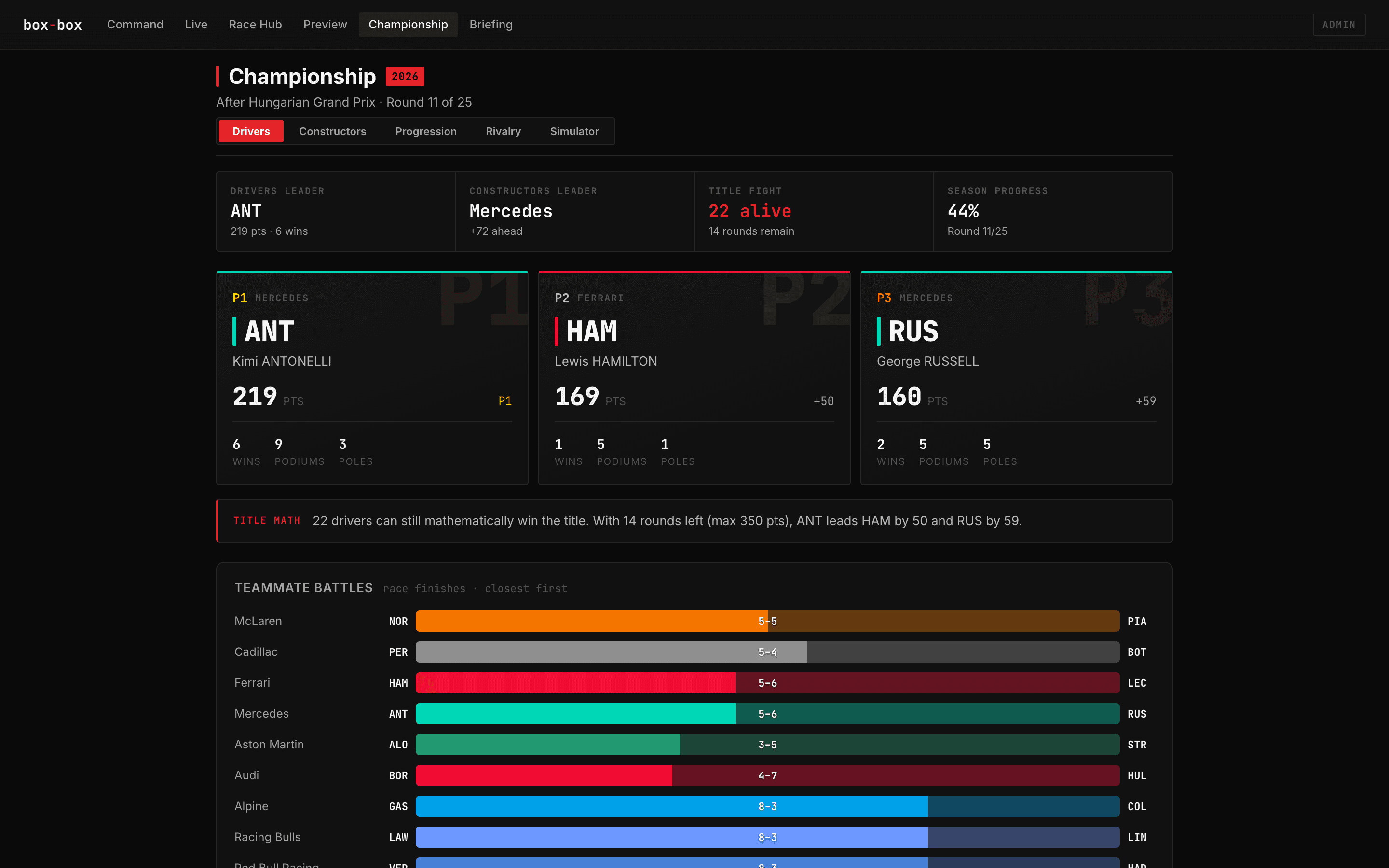
An F1 race-weekend command center in Go and React. Live timing bridged from the official SignalR feed to the browser, and a local SQLite history that works when nothing is live, because for most of the year, nothing is.

GO · REACT · SQLITE · SSE · BUBBLE TEA
The box-box championship view after the Hungarian Grand Prix, with championship leaders, three driver cards, a title-math callout, and teammate-battle bar charts.
Championship standings on the live deployment: driver cards, title math, and teammate battles. Open the box-box case study.

gringotts and the ministry of magic

A Raspberry Pi and a mini PC that don't just run services, they run agents. Scheduled agentic workflows I can drive from my phone, and a resident agent on Discord that has been awake longer than any chat session.

DOCKER · NGINX · TAILSCALE · OPENCHAMBER · IaC

I work at Health Recovery Solutions on the Rimidi platform.

I continued with the platform after HRS acquired Rimidi on 1 March 2026, supporting its ongoing development, helping teammates build context, and contributing to the architecture for bringing the two products together. I also run each sprint release across 61 AWS ECS production instances through Jenkins.

Before that: FHIR pipelines standardizing Epic and Cerner data for 20,000+ patients a day, a Georgia Tech MSCS, and four published papers.

Full history